
Fukuyama: "People that live in a democracy need to understand a little bit about the theory behind democracy"
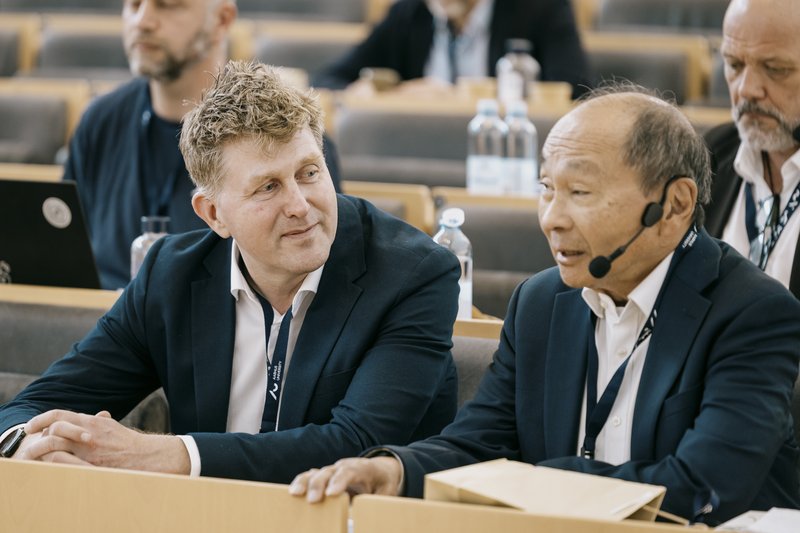
Recently, Francis Fukuyama, Professor of Political Science and Olivier Nomellini Senior Fellow at Stanford University, took part in MatchPoints 2026 at Aarhus University to discuss the importance of trust in society and global politics. Ahead of the event, we spoke with him for a joint interview alongside Mads Rosendahl Thomsen, Professor of Comparative Literature and Director of the TEXT, about geopolitics, the role of the humanities in sustaining democracy, and the challenges posed by AI.

Francis Fukuyama, I'll start by asking for your perspective on the current situation of the world and the years to come. And in your speech from last year, why liberals must not give up hope available on persuasion, you write that the world that existed before 2016 is not coming back. What do you mean by that?
Fukuyama: Well, I think the United States had created a liberal world order after 1945 that involved free trade alliances like the NATO alliance, general rules about freedom of navigation, wanting an open economic order and a democratic political order around the world. And the United States is just under Donald Trump not interested in any of those things. It's turned protectionist. I think it is on its way to pulling out of NATO. And in general, it doesn't support global democracy. In fact, Trump has been eager to make friends with the world's autocrats like Putin and Xi Jinping. So, I think that's the major disturbance in world order that's occurred. And because of the role that the United States played previously, it's going to affect very many other countries.
What challenges does this pose for future generations?
Fukuyama: The obvious challenge for Europe is to somehow compensate for the loss of American support. I mean, I don't know that it's going to be permanently gone, but I don't think that it's wise for any European leader to assume that the United States is going to come to its assistance if it's attacked by Russia or, you know, their security, you know, threats coming from whatever source. So, that means that Europeans are going to have to be much more self-reliant.
In the same speech, you also mentioned how a liberal democracy and the ability to make political choices is a gift that needs to be nurtured and developed by every citizen. What role does humanities play in this regard on a societal level, if any?
Fukuyama: I think that people that live in a democracy need to understand a little bit about the theory behind democracy. You know, why popular choices is legitimate, why limited government is effective government. These are all things that, you know, come out of certain theories about how societies work. And I think that if you don't understand the, you know, the way in which these institutions develop, you're not going to appreciate them. And therefore, you're not going to act to protect them.
Thomsen: Some of the great dystopian novels of the twentieth century clearly show how independent thinking and the reading of books are among the first things to be suppressed. In Brave New World by Aldous Huxley, people read William Shakespeare outside the boundaries of a tightly controlled society. In Nineteen Eighty-Four, George Orwell imagines a world where language is manipulated to make free thought impossible, while in Fahrenheit 451 by Ray Bradbury, books are burned altogether. Across these stories, the ability to think critically and independently — grounded in an understanding of history — is portrayed as a fundamental value under attack. And that threat is not confined to fiction - in many parts of the world today, books are still being censored
Can you give an example of a piece of art or culture that in your opinion or perhaps from your personal experience cultivates you?
Fukuyama: I think that the Federalist Papers that were written at the time of the ratification of the American Constitution are really basic treatises on how democratic government is supposed to work that define things like the separation of powers and the nature of a kind of regime that's characterized by the constitutional checks and balances. And I think if you appreciate those papers, you will understand, you know, the way that American government is supposed to work.
Thomsen: Historical novels are fascinating in the way they imagine social change and possible futures. Take Lykke-per by Henrik Pontoppidan, published in 1904. The novel explores power structures in society, ambitious attempts to reshape the landscape — on a scale not entirely unlike today’s Green Tripartite Agreement — and even technological visions of travelling across the Atlantic in six hours or speaking to someone in China as if they were standing right beside you. It also raises the question of whether we have lost the capacity for utopian thinking. Perhaps the best future we can imagine today is simply one in which we avoid catastrophe as in The Ministry for the Future by Kim Stanley Robinson.
Technological development and change in regards to AI are projected to change if it is not happening already, our labor market and society fundamentally. What challenges does this outlay for our democratic institutions?
Fukuyama: Well, I think the greatest fear is one of inequality, that AI is going to increase the gap between the winners and losers, you know, so a small number of people will become fabulously rich and other people may actually lose their livelihoods because they're being replaced by a machine. And that fear, I think, on an international level also, where countries that are at the forefront of AI will become much more powerful than countries that don't have it. I think what we have to do is, you know, wait and observe the effects that it has. You know, it's widely expected to eliminate a lot of service sector jobs and we need to see whether that's true or whether actually it complements the activities that people are already doing and in many ways makes them better off. We simply don't know.
Thomsen: Ideally, artificial intelligence should make it easier for people to educate themselves and take part more meaningfully in democratic debate. But judging from our experience with social media, that may be far too optimistic. We are also living through a period of uncertainty, as AI has the potential to bring about profound changes in many areas of society. Perhaps those changes will unfold more gradually and less dramatically than some fear, but it would be naive to claim that we already understand where this development is heading.
Background
Francis Fukuyama is one of the most influential political thinkers of our time and is particularly known for The End of History and the Last Man, published in 1992. As Professor of Political Science at Stanford University, his research focuses on democracy, international relations, state-building, and political development.
For decades, Fukuyama has shaped the global debate on liberalism, authoritarian tendencies, and the future of democracy. Most recently, he published Liberalism and Its Discontents in 2022. His forthcoming memoir, In the Realm of the Last Man: A Memoir, will be published this autumn by Profile Books.
Contact
Mads Rosendahl Thomsen
Professor of Comparative Literature and Director of TEXT
School of Communication and Culture
Department of Comparative Literature and Rhetoric
Aarhus University
Email: madsrt@cc.au.dk
Phone: +45 3114 1419
Web: TEXT – Aarhus University