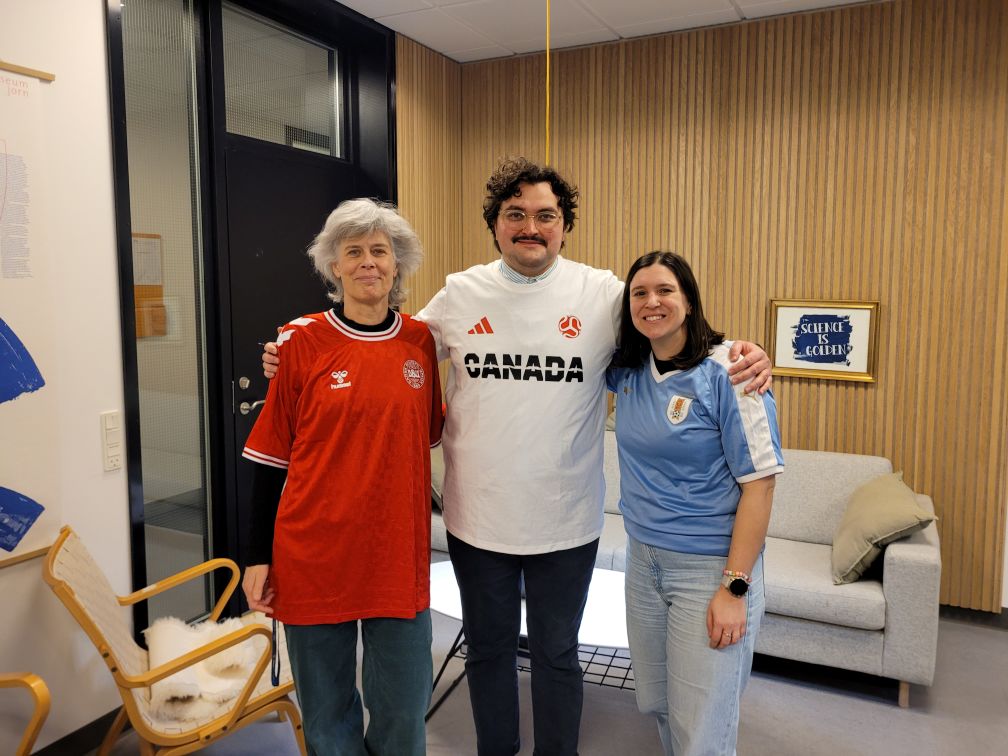
The “Soft ‘power play’ at the 2026 FIFA World Cup” project offers fresh perspectives into the intersections of sport, politics, conflict, and media by investigating audience experiences of the 2026 FIFA World Cup. Sport mega-events—like the Olympic Games and Football World Cups—are crucial objects in mediatized politics, intertwined with popular culture, and permeated by emotions and identity politics. The project, funded under the AUFF Nova scheme, is led by Principal Investigator Prof. Kirsten Frandsen and postdoctoral fellows Cecilia Arregui Olivera and Vitaly Kazakov.
The 2026 FIFA World Cup is co-hosted by the United States, Mexico, and Canada. The United as One (2018) bid articulated visions of harmony and peace through football and sought to counter Donald Trump’s divisive discourse. However, the event has also become a tool for the US President’s geopolitical ‘power plays’ and authoritarian populism, while Canada and Mexico contend with threats to sovereignty and economic challenges from their dominant co-host. This project thus explores how (geo)political instability and tension around the World Cup shape media audience experiences in Canada and Mexico, the two smaller players in the bid which have distinct political, media, and sports systems. The aim is to develop and test a new theoretical framework for understanding the soft power of such events in a context of power dynamics between centre and relative periphery.
Theoretically, the project combines interdisciplinary insights from sports diplomacy, emotion-driven politics, mediatization, and media systems theory to analyse mediatized political tensions in sports mega-events. The qualitative research design combines media framing analysis of mainstream media and fieldwork with Canadian and Mexican media audiences during the 2026 World Cup. This includes observations and focus group interviews with 3-4 groups watching live games, representing varying levels of engagement—from dedicated football fans, mainstream interest, and politically engaged. Follow-up interviews, surveys on their event-related media diet, and data donation of their digital communication flows will provide further enrich the findings.